Introduction
A manufacturing plant can have modern machinery and experienced operators, but production can still be affected when equipment is unavailable at the wrong time. Unexpected bearing failures, overheating, electrical faults, lubrication problems, misalignment and worn components can interrupt production and create additional maintenance work. Improving machine uptime therefore requires more than repairing equipment after a breakdown.
Machine uptime refers to the period during which equipment is available and capable of performing its intended function. For manufacturing businesses, improving uptime involves identifying factors that cause machine downtime, maintaining equipment correctly and responding to early warning signs before they develop into major failures..
What Is Machine Uptime?
Machine uptime is the amount of time equipment remains operational and available for production. It is commonly considered alongside downtime and availability when evaluating equipment performance.
For example, if a production machine is scheduled to operate for a defined period but spends part of that time stopped because of equipment failure, maintenance or other interruptions, its available operating time is reduced.
However, uptime should not be considered only as a percentage. A machine that operates for long periods but produces inconsistent output or requires frequent emergency intervention may still indicate an underlying reliability problem.
This is why equipment reliability, maintenance history and machine performance should be considered together when assessing production equipment.
Why Is Machine Uptime Important in Manufacturing?
Manufacturing processes often depend on multiple machines working together. If one critical machine stops, the interruption may affect other stages of production.
For example, a failure in a conveyor system can prevent material from reaching the next production stage. A pump failure can affect a process that depends on continuous fluid circulation. A compressor problem can affect pneumatic equipment throughout a facility.
The effect of downtime therefore depends on the machine’s position within the production process. Critical equipment requires appropriate maintenance priority because its failure can have a wider operational impact.
What Causes Low Machine Uptime?
Low machine uptime can result from several technical and operational factors. Equipment age is only one consideration. Poor maintenance practices, incorrect installation, inadequate lubrication, excessive loading, unsuitable operating conditions and delayed repairs can also contribute to reduced reliability.
Poor Preventive Maintenance
When routine maintenance activities are delayed, developing equipment problems may remain undetected. Lubrication, cleaning, inspection, alignment and component checks can be particularly important for machinery containing moving parts.
A preventive maintenance program should be based on equipment requirements rather than simply applying the same maintenance interval to every machine.
Excessive Mechanical Wear
Mechanical components gradually wear during normal operation. Bearings, belts, couplings, gears, seals and other components can deteriorate depending on load, speed, lubrication and operating environment.
If wear is not identified at an appropriate stage, it can affect connected components and eventually cause unplanned machine downtime.
Misalignment and Imbalance
Rotating equipment can experience additional vibration and mechanical loading when shafts, couplings or other components are incorrectly aligned or balanced.
These conditions may initially have limited visible impact but can progressively increase bearing and coupling wear. Proper inspection and alignment procedures can therefore contribute to better equipment reliability.
Lubrication Problems
Lubrication is essential for many mechanical systems. Insufficient lubricant, contamination, incorrect lubricant selection or inappropriate application can increase friction and temperature.
A lubrication program should follow equipment requirements and manufacturer recommendations. Maintenance personnel should also monitor for signs of leakage, contamination or abnormal operating temperature.
Delayed Response to Warning Signs
Operators and technicians often notice changes before a machine experiences a major failure. Unusual noise, vibration, temperature changes, leakage or reduced performance can provide useful information.
If these observations are ignored or not recorded, an opportunity for early intervention can be lost.
How Preventive Maintenance Improves Machine Uptime
Preventive maintenance is one of the basic methods used to reduce avoidable equipment failures. Instead of waiting for equipment to fail, maintenance activities are scheduled according to time, operating hours, production cycles or other defined requirements.
Typical activities may include lubrication, cleaning, tightening, alignment checks, inspection and scheduled component replacement.
The effectiveness of preventive maintenance depends on how well the maintenance intervals match actual equipment conditions. Maintenance performed too infrequently may allow deterioration to progress, while unnecessary maintenance can consume resources without providing proportional benefits.
For this reason, maintenance teams should periodically review equipment history and adjust maintenance requirements where appropriate.
Use Condition Monitoring to Detect Deterioration
Condition monitoring provides information about the actual operating condition of equipment. Depending on the machine, this may include vibration measurement, temperature monitoring, oil analysis, visual inspection or other technical methods.
For rotating equipment, vibration trends can provide useful information about developing mechanical problems. An increasing vibration level may require investigation for issues such as imbalance, misalignment, looseness or bearing deterioration.
Temperature monitoring can also identify abnormal operating conditions. A gradual temperature increase may indicate increased friction, lubrication problems or other equipment issues.
Condition monitoring does not eliminate the possibility of failure, but it can give maintenance teams additional information for deciding when further investigation or corrective work may be required.
Improve Equipment Inspection Practices
Routine equipment inspection should focus on changes in equipment condition rather than simply confirming that a machine is running.
Operators can perform basic observations during normal operation, while maintenance personnel can conduct more detailed inspections according to the equipment and maintenance program.
Inspection records should include observations and measurements where appropriate. Comparing current findings with previous records can help identify trends that may not be obvious from a single inspection.
For critical assets, more detailed inspection or testing may be appropriate depending on the equipment and its application.
Monitor Machine Availability
Machine availability provides another way to evaluate equipment performance. It considers whether equipment is available for operation when required.
A machine can experience downtime because of equipment failure, planned maintenance, changeovers, material shortages or other production-related reasons. Maintenance teams should therefore distinguish between different causes of downtime when reviewing performance.
If equipment failure represents a significant portion of downtime, maintenance records can be analyzed to identify the most common failure modes and the assets responsible for the largest interruptions.
Track the Root Causes of Machine Downtime
Simply recording total downtime does not explain why it happened. Maintenance teams should document the cause of each significant interruption where possible.
For example, repeated downtime associated with a specific pump may indicate a recurring mechanical or operational problem. If the pump repeatedly experiences bearing failures, replacing the bearing without investigating alignment, lubrication, load or installation conditions may not resolve the issue.
Root-cause analysis can help determine whether the problem originates from equipment condition, maintenance practices, operating procedures or another factor.
This approach supports more effective maintenance planning and helps businesses focus resources on recurring problems.
Improve Spare Parts Planning
Spare-parts availability can influence how quickly a machine returns to operation after a failure. A relatively simple repair can become a prolonged interruption if the required component is unavailable.
Maintenance teams should identify critical spare parts based on equipment importance, component failure history, supplier lead times and the availability of alternatives.
The goal is not to store every possible spare part. Instead, businesses should identify components where availability can significantly affect equipment recovery time.
Train Operators to Identify Early Warning Signs
Machine operators interact with production equipment regularly and can often identify changes in normal operating behaviour.
Operators should understand how to recognize unusual noise, vibration, leakage, temperature changes and other abnormal conditions. They should also know how and when to report these observations to the maintenance team.
Operator observations do not replace professional inspection. However, combining operator feedback with maintenance records can provide a more complete picture of equipment condition.
Improve Maintenance Planning
A reactive maintenance approach can cause maintenance teams to spend much of their time responding to emergencies. A more structured industrial maintenance process gives teams the opportunity to plan routine work and prioritize equipment according to criticality.
Maintenance planning should consider production schedules, equipment condition, required tools, personnel and spare parts. Planned work can then be coordinated with production to minimize unnecessary interruptions.
For critical equipment, maintenance planning should also include contingency arrangements where appropriate.
Calculate Machine Uptime and Availability
A simple uptime calculation can help businesses understand equipment performance.
Machine Uptime = Operating Time ÷ Scheduled Production Time × 100
For example, if a machine is scheduled to operate for 500 hours and is available for 475 hours, its uptime based on this simplified calculation would be:
475 ÷ 500 × 100 = 95%
This calculation provides a useful measurement, but businesses should also examine why the remaining 25 hours were lost. A single percentage cannot explain whether downtime resulted from mechanical failure, planned maintenance, setup activities or another cause.
Machine Uptime in UAE Manufacturing Facilities
Manufacturing and industrial operations across Dubai and Abu Dhabi rely on different types of production and support equipment. The appropriate maintenance strategy depends on the machinery, operating conditions, production requirements and equipment criticality.
Industrial locations such as Jebel Ali, Dubai Industrial City and Mussafah contain a range of manufacturing and engineering operations. Equipment used in these environments may include rotating machinery, pumps, compressors, conveyors, production machines and utility systems.
For businesses operating in Sharjah, Ajman and Ras Al Khaimah, similar principles apply. A structured factory maintenance UAE program can help businesses organize preventive maintenance, equipment inspections, condition monitoring and planned corrective work.
The local environment can influence maintenance requirements, but equipment specifications and actual operating conditions should remain the primary factors when determining maintenance procedures and inspection intervals.
10 Practical Ways to Improve Machine Uptime
Improving machine uptime usually requires several maintenance practices working together rather than a single solution. Businesses can begin by identifying critical equipment and understanding the main causes of its downtime.
Regular preventive maintenance should then be combined with appropriate condition monitoring and equipment inspection. Maintenance teams should also keep accurate records of failures, repairs, component replacements and recurring problems.
Spare parts should be planned according to equipment criticality, while operators should be trained to identify and report unusual machine behaviour. Planned shutdowns can be used for maintenance activities that cannot be safely completed during production.
Finally, maintenance performance should be reviewed periodically. If the same equipment continues to experience failures despite scheduled maintenance, the maintenance strategy should be reassessed rather than simply repeating the same repair process.
Machine Uptime Improvement Checklist
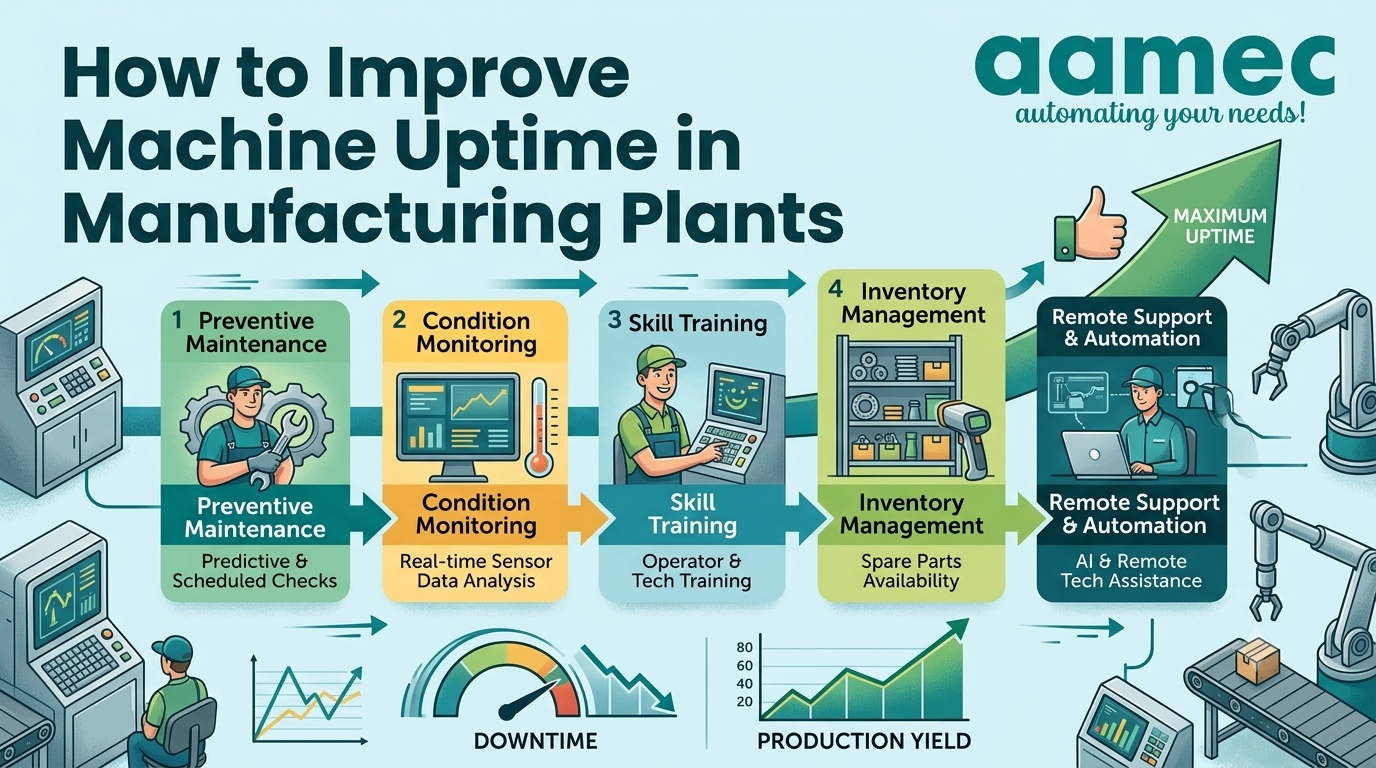
A practical uptime improvement program can include:
- Identify production-critical machines.
- Record the main causes of machine downtime.
- Establish appropriate preventive maintenance activities.
- Monitor equipment condition where practical.
- Inspect critical mechanical components.
- Maintain accurate repair and failure records.
- Plan critical spare parts.
- Train operators to identify abnormal conditions.
- Investigate recurring equipment failures.
- Coordinate major maintenance with planned shutdowns.
- Review uptime and availability data regularly.
When Should a Machine Be Investigated Professionally?
Professional technical investigation should be considered when a machine experiences repeated failures, unexplained performance changes, persistent vibration, abnormal temperatures or recurring component damage.
It can also be useful when maintenance teams have replaced components several times without resolving the underlying problem. Repeated failures may indicate an issue with alignment, loading, lubrication, installation, operating conditions or another part of the system.
Businesses looking for machine maintenance Dubai or machine maintenance Abu Dhabi support should consider the provider’s technical capabilities and experience with the specific equipment involved rather than selecting a service based only on location.
How AAMEC Supports Industrial Operations
AAMEC supports industrial and engineering requirements through inspection, testing and related technical services. For businesses focused on improving equipment reliability, appropriate inspection and testing can provide useful technical information when evaluating equipment condition and maintenance requirements.
Companies operating manufacturing plants UAE can assess their inspection and testing needs according to equipment type, operating conditions, criticality and maintenance history. A structured technical assessment can support maintenance planning and help businesses understand equipment condition more clearly.
For facilities across Dubai, Abu Dhabi and other UAE industrial locations, the appropriate service should always be determined by the equipment and the specific technical requirement.
Frequently Asked Questions
What is machine uptime?
Machine uptime refers to the period when equipment is available and capable of performing its intended production function. It is commonly evaluated alongside downtime and machine availability to understand equipment performance.
How can I improve machine uptime?
To improve machine uptime, businesses can combine preventive maintenance, equipment inspection, condition monitoring, operator training, spare-parts planning and root-cause analysis. The most effective approach depends on the equipment and the reasons for existing downtime.
What causes machine downtime?
Common causes include mechanical wear, lubrication problems, misalignment, bearing failure, electrical faults, overheating, improper operation, inadequate maintenance and component failure. Production-related activities can also create downtime, so maintenance and production causes should be recorded separately where possible.
Does preventive maintenance improve machine uptime?
Preventive maintenance can help reduce avoidable equipment failures by identifying and addressing known maintenance requirements before certain failure conditions develop. Its effectiveness depends on selecting appropriate maintenance activities and intervals for the equipment.
What is the difference between uptime and availability?
Uptime generally describes the time equipment is operating or available compared with a defined operating period. Availability considers whether the equipment is ready for operation when required. The exact calculation can vary depending on the performance measurement system used by the organization.
How does condition monitoring help improve equipment reliability?
Condition monitoring tracks equipment characteristics such as vibration, temperature or other relevant parameters. Changes in these measurements can provide indications of developing problems and help maintenance teams determine when further investigation may be required.
How often should manufacturing equipment be inspected?
Inspection frequency depends on the equipment type, operating conditions, manufacturer recommendations, criticality and maintenance history. Critical machinery may require more frequent monitoring than equipment with lower operational impact.
Where can manufacturing companies get machine maintenance support in the UAE?
Manufacturing companies can evaluate industrial maintenance UAE providers according to their technical capabilities, equipment experience and specific requirements. Businesses in Dubai, Abu Dhabi, Sharjah and other UAE industrial areas should select maintenance or inspection services based on the equipment and intended technical objective.
Conclusion
Improving machine uptime requires a structured understanding of why equipment becomes unavailable and what can be done to identify problems earlier. Preventive maintenance, condition monitoring, equipment inspection, spare-parts planning and accurate maintenance records all contribute to a more controlled approach to equipment reliability.
Manufacturing businesses should also look beyond the uptime percentage itself. Understanding the causes of machine downtime provides more useful information for maintenance planning and allows teams to focus on recurring problems that have the greatest operational impact.
For manufacturing plants UAE, including facilities operating in Dubai, Abu Dhabi, Sharjah and other industrial locations, maintenance strategies should be developed around the actual equipment, operating conditions and production requirements. Combining planned maintenance with condition-based assessment can provide a practical foundation for improving equipment reliability and maintaining more consistent machine availability.