Introduction
Restarting industrial equipment after a shutdown should not be treated as simply switching the machine back on. Equipment that has remained idle for an extended period may have changes in lubrication, electrical condition, mechanical alignment, fluid levels, connections or safety systems. A structured inspection before startup can identify these conditions before they develop into equipment damage or an unexpected production interruption.
An equipment restart checklist provides maintenance teams and operators with a systematic way to verify that machinery is ready for operation. The exact checks depend on the equipment type, shutdown duration, operating environment and manufacturer’s instructions, but the basic principle remains the same: confirm equipment condition before returning it to service.
For factories and industrial facilities across Dubai, Abu Dhabi, Sharjah and other UAE locations, restart inspections can be particularly important after planned maintenance, extended production stoppages, equipment modifications or seasonal shutdowns. A properly performed equipment inspection UAE process can help identify issues before production resumes.
Why Equipment Should Be Inspected Before Restarting
During normal operation, equipment generates movement, heat, vibration and other operating conditions that maintenance teams can monitor. When a machine is shut down, these conditions change. Components may remain stationary for an extended period, fluids may settle, connections may be disturbed during maintenance and external conditions can affect exposed equipment.
A shutdown may also involve maintenance work, component replacement or modifications. If a coupling, guard, electrical connection or mechanical component was removed during the shutdown, it should be checked before the machine is returned to service.
Restarting without verification can therefore introduce avoidable risks. The purpose of a pre-start inspection is to confirm that the equipment, its supporting systems and relevant safety controls are ready for operation.
What Is an Equipment Restart Checklist?
An equipment restart checklist is a structured list of inspections and verification steps completed before industrial equipment is started after a shutdown.
The checklist can cover mechanical condition, lubrication, electrical connections, safety devices, fluid systems, guards, controls and the surrounding work area. It can also include confirmation that maintenance work has been completed and that tools, temporary supports and other materials have been removed.
A good checklist should be specific enough for the equipment being restarted. A pump, compressor, conveyor, generator and production machine will not necessarily require the same checks.
Review the Shutdown and Maintenance History
Before inspecting the machine, maintenance personnel should review why the equipment was shut down and what work was performed during the shutdown.
Maintenance records can identify replaced components, repairs, modifications, inspection findings and outstanding issues. This information helps the team focus its pre-start inspection on areas that may have been affected.
If a bearing was replaced, for example, the associated installation, lubrication and alignment should be verified. If electrical work was performed, the relevant electrical connections and isolation procedures should be checked according to the applicable safety requirements.
The restart process should therefore begin with information from the shutdown rather than relying only on a visual inspection.
Perform a General Visual Inspection
A general visual inspection is one of the first steps in a machine restart procedure. The equipment should be examined for visible damage, loose components, leakage, corrosion, contamination and other abnormal conditions.
The area around the machine should also be checked. Tools, maintenance materials, temporary supports, packaging or other objects should not remain in locations where they could interfere with moving parts or equipment operation.
Any guards or covers removed during maintenance should be correctly reinstalled before startup. The equipment should not be operated if an important protective component is missing or incorrectly installed.
Check Mechanical Components
Mechanical components should be inspected according to the equipment design and maintenance requirements. This may include shafts, bearings, couplings, belts, chains, gears, fasteners, seals and mounting arrangements.
Components that were repaired or replaced during the shutdown deserve particular attention. The maintenance team should verify that the work has been completed correctly and that relevant connections are secure.
For rotating machinery, manual rotation or other pre-start checks may be appropriate where permitted by the equipment manufacturer’s procedure. This can help identify obvious mechanical resistance or interference before powered operation.
The correct method depends on the machine and should follow the manufacturer’s instructions and site safety procedures.
Check Lubrication and Fluid Levels
Lubrication is an important part of industrial equipment maintenance. Before startup, maintenance personnel should verify that the required lubricants are present and that lubrication points have been serviced according to the equipment requirements.
The type and quantity of lubricant should be appropriate for the equipment. Over-lubrication can also create problems, so adding lubricant simply because the machine has been shut down is not necessarily appropriate.
Hydraulic systems, cooling systems, gearboxes and other equipment using fluids should also be checked for appropriate levels, leakage and visible contamination where applicable.
Any fluid-related inspection should follow the equipment manufacturer’s recommendations.
Check Alignment and Couplings
Equipment that was dismantled or moved during shutdown may require alignment verification before restarting.
Misalignment between connected rotating equipment can increase vibration and mechanical loading. If a motor, pump, gearbox or other component was removed or repositioned, the relevant alignment should be checked according to the equipment and maintenance procedure.
Couplings should also be inspected for condition, installation and appropriate protection. Incorrectly installed or damaged coupling components can create vibration and mechanical failure after startup.
These checks are particularly important when returning repaired rotating machinery to operation.
Inspect Belts, Chains and Drive Components
Machines that use belts, chains or other transmission systems should be inspected before startup. Maintenance personnel should look for excessive wear, damage, incorrect tension, contamination or other conditions that may affect operation.
Drive components should also be properly guarded before the machine starts. A missing or incorrectly fitted guard can create a serious safety hazard around moving machinery.
The correct tension and adjustment should be determined according to the equipment manufacturer’s requirements rather than using a universal value.
Check Electrical Connections and Controls
Electrical checks should be performed by appropriately qualified personnel according to the equipment and applicable site procedures.
Where electrical work was carried out during the shutdown, relevant connections, panels, cables, protective devices and control systems should be verified before energizing the equipment.
The condition of emergency-stop systems, control switches, indicators and relevant interlocks should also be confirmed where applicable.
Electrical inspection requirements vary significantly between equipment types. Maintenance personnel should therefore follow the manufacturer’s documentation and the facility’s electrical safety procedures.
Verify Safety Guards and Protective Systems
Safety systems should never be treated as optional restart items. Guards, covers, emergency stops, interlocks and other protective systems should be checked before equipment is returned to operation.
The machine’s operating area should also be clear of unauthorized personnel. Workers who need to be present during startup should understand the relevant procedures and hazards.
If a protective system does not function as intended, the equipment should not be returned to normal operation until the issue has been addressed according to the site’s safety procedure.
Check the Work Area Before Startup
The equipment itself is only one part of a safe restart. The surrounding area should also be inspected.
Maintenance tools, lifting equipment, cables, cleaning materials and temporary barriers should be removed or positioned correctly. Any work permits, isolation procedures or maintenance controls associated with the shutdown should be closed according to site procedures before startup.
The team should also confirm that people who worked on the equipment are aware that the machine is about to be restarted.
Clear communication is particularly important when several maintenance teams or contractors have worked on the same equipment.
Confirm Utilities and Supporting Systems
Many industrial machines depend on supporting systems such as compressed air, cooling water, hydraulic systems, electrical supply, ventilation or process fluids.
Before startup, these supporting systems should be checked according to the equipment requirements. Incorrect pressure, inadequate flow or an unavailable utility can prevent the machine from operating correctly and may damage components.
A machine should therefore not be considered ready simply because its main components appear to be in good condition. Its supporting systems must also be available and within the required operating conditions.
Perform a Controlled Test Run
After the pre-start checks have been completed, the equipment may be started according to the manufacturer’s and facility’s restart procedure.
The initial startup should be monitored carefully. Maintenance personnel should observe vibration, noise, temperature, pressure, leakage and other relevant operating parameters.
A controlled test run allows the team to identify abnormal conditions before the equipment returns to full production load.
If abnormal noise, excessive vibration, unusual temperature, leakage or other unexpected behaviour is observed, the machine should be handled according to the site’s shutdown and troubleshooting procedures rather than continuing operation simply to complete the restart.
Monitor the Equipment After Restart
Passing the initial startup check does not necessarily mean the restart process is complete. Equipment should be monitored during the early operating period, particularly if significant maintenance or component replacement was performed.
The team can compare operating parameters with previous records or normal operating ranges. Any significant deviation should be investigated.
For critical machinery, additional condition monitoring may be appropriate after major maintenance or extended shutdown periods.
Post-restart observations should also be documented in the maintenance record so they can be compared with future inspections.
Equipment Restart Checklist
The following checklist provides a general reference for industrial equipment:
- Review the shutdown and maintenance history.
- Confirm all planned maintenance work is complete.
- Perform a general visual inspection.
- Check for loose or damaged components.
- Inspect bearings, shafts and couplings.
- Verify lubrication and fluid levels.
- Check belts, chains and drive components.
- Verify alignment where applicable.
- Confirm guards and protective systems are installed.
- Check electrical connections and controls where applicable.
- Verify supporting utilities.
- Clear tools and materials from the equipment area.
- Confirm personnel are clear before startup.
- Perform a controlled test run.
- Monitor vibration, noise, temperature and other relevant parameters.
- Record post-restart observations.
This maintenance checklist should be adapted to the specific equipment and site procedure. It should not replace the manufacturer’s instructions or applicable safety requirements.
Common Mistakes During Equipment Restart
One of the most common mistakes is assuming that equipment will return to its previous condition simply because the shutdown was planned. Equipment condition can change during an extended idle period, and maintenance work can introduce new conditions that require verification.
Another mistake is restarting immediately after completing mechanical work without checking the surrounding area. Tools, temporary components or incorrectly installed guards can create operational and safety problems.
Skipping lubrication or fluid checks is another common issue. Equipment that depends on proper lubrication or cooling should not be started without confirming the relevant requirements.
Finally, maintenance teams should avoid treating the first few minutes of operation as unimportant. Initial operating behaviour can provide useful information about whether the equipment has returned to its expected condition.
Equipment Restart After Long Shutdowns
An extended shutdown may require additional inspection compared with a short production stoppage. The longer equipment remains idle, the more important it becomes to review storage conditions, lubrication requirements, corrosion, contamination and other equipment-specific factors.
Machines exposed to moisture, dust or other environmental conditions may require additional inspection before startup. Equipment with fluid systems may also require specific checks after extended inactivity.
The exact procedure should be based on the manufacturer’s recommendations and the duration and conditions of the shutdown.
Equipment Restart Practices in UAE Industrial Facilities
Factories and industrial facilities across Dubai, Abu Dhabi and Sharjah may restart equipment following planned maintenance, production shutdowns, facility modifications or extended periods of inactivity.
Industrial areas such as Jebel Ali, Dubai Industrial City and Mussafah contain manufacturing and engineering operations where machinery restart procedures can form part of wider factory maintenance UAE programs.
Businesses operating in Ajman, Ras Al Khaimah and Fujairah may also have different equipment and operating conditions that require customized restart procedures. The appropriate industrial equipment inspection UAE process should therefore be based on the actual machine, shutdown duration, maintenance performed and manufacturer’s requirements.
Local conditions should be considered, but they should not replace equipment-specific technical procedures.
When Should Professional Equipment Inspection Be Considered?
Professional equipment inspection may be appropriate when equipment has undergone major repairs, significant modifications, extended shutdowns or repeated failures.
It can also be useful when abnormal conditions are detected during a restart or when maintenance personnel require additional technical assessment before returning critical equipment to operation.
Businesses seeking equipment inspection Dubai or equipment inspection Abu Dhabi services should evaluate the provider according to the type of equipment, inspection method, technical capability and specific requirement rather than relying only on location.
How AAMEC Supports Industrial Operations
AAMEC supports industrial and engineering requirements through inspection, testing and related technical services. For businesses preparing equipment for operation after maintenance or shutdown, appropriate technical inspection and testing can provide additional information about equipment condition where required.
Companies operating across Dubai, Abu Dhabi and other UAE industrial locations can determine the appropriate inspection or testing requirements based on equipment type, maintenance history, operating conditions and the purpose of the assessment.
A technical inspection should complement, rather than replace, the equipment manufacturer’s restart procedure and the facility’s established safety practices.
Frequently Asked Questions
What should be checked before restarting industrial equipment?
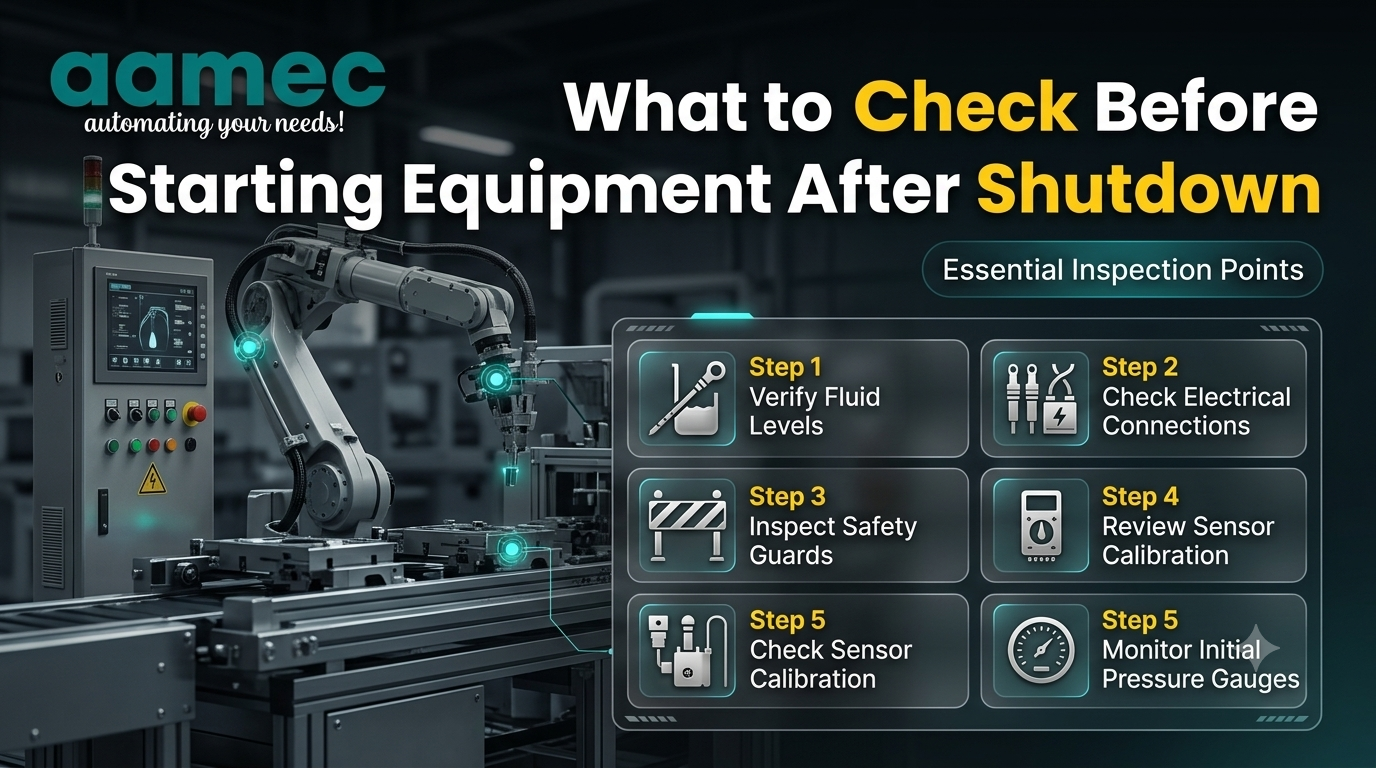
Before restarting equipment, maintenance teams should review the shutdown history, inspect mechanical components, verify lubrication and fluid levels, check relevant electrical systems, confirm safety guards, inspect supporting utilities and ensure the work area is clear. The exact equipment restart checklist should be adapted to the specific machine.
Why is an equipment restart checklist important?
An equipment restart checklist provides a structured method for verifying equipment condition before operation. It helps maintenance teams avoid overlooking basic checks after maintenance, repairs or extended shutdowns and provides a record that the required verification activities were completed.
Should equipment be inspected after a long shutdown?
Yes, equipment that has been inactive for an extended period may require additional inspection. The appropriate checks depend on the duration of the shutdown, storage conditions, equipment type, maintenance performed and manufacturer’s recommendations.
What should be checked after equipment maintenance?
After maintenance, verify that components were installed correctly, fasteners are secure, lubrication and fluid levels are appropriate, guards are installed, tools and temporary materials have been removed, and relevant controls and safety systems are functioning as required.
Should machinery be monitored after restarting?
Yes. Initial operation should be monitored for abnormal vibration, noise, temperature, leakage, pressure or other relevant operating conditions. Monitoring is particularly important after major maintenance or component replacement.
Who should perform an equipment restart inspection?
The inspection should be performed by personnel with the appropriate knowledge and authorization for the equipment and the required checks. Electrical or specialized technical inspections should be performed by suitably qualified personnel according to site procedures and applicable requirements.
What happens if equipment shows abnormal conditions after startup?
Abnormal vibration, noise, temperature, leakage or other unexpected conditions should be investigated according to the site’s operating and safety procedures. Continuing to operate equipment with an unresolved abnormal condition can increase the risk of damage.
Where can businesses get equipment inspection services in the UAE?
Businesses can evaluate industrial equipment inspection UAE providers according to their technical capabilities, inspection scope, equipment experience and specific requirements. Companies in Dubai, Abu Dhabi, Sharjah and other UAE industrial areas should select inspection services based on the actual equipment and purpose of the assessment.
Conclusion
Restarting equipment after a shutdown requires more than restoring power and pressing the start button. Mechanical components, lubrication, alignment, electrical systems, safety devices, supporting utilities and the surrounding work area should be checked according to the equipment’s requirements.
A structured equipment restart checklist gives maintenance teams a practical method for completing these checks and documenting the results. After startup, monitoring vibration, temperature, noise and other relevant operating conditions can help identify problems that may not have been visible during the initial inspection.
For industrial facilities across Dubai, Abu Dhabi, Sharjah and other UAE locations, restart procedures should be adapted to the equipment, shutdown duration, maintenance work performed and manufacturer’s requirements. Combining planned industrial equipment maintenance UAE practices with appropriate inspection and controlled startup procedures can support safer and more reliable equipment operation.