Introduction
Small mechanical problems are often easy to overlook when equipment is still running. A machine may continue operating despite abnormal vibration, a worn bearing, loose coupling, poor lubrication, or unusual noise. However, continuing to operate equipment with these warning signs can gradually increase mechanical maintenance cost and create more serious repair requirements.
In an industrial environment, a minor mechanical issue rarely remains isolated. Excessive vibration can accelerate bearing wear, poor lubrication can increase friction and temperature, and misalignment can place additional loads on shafts and couplings. If these conditions are not identified during routine equipment inspection, the original problem can develop into a component failure or an unexpected production stoppage.
For factories and industrial facilities across Dubai, Abu Dhabi, Sharjah and other parts of the UAE, controlling maintenance expenses requires more than repairing equipment after it breaks down. A planned approach to industrial equipment maintenance helps maintenance teams identify developing faults, prioritize critical assets and decide when corrective work should be carried out.
What Happens When Small Mechanical Problems Are Ignored?
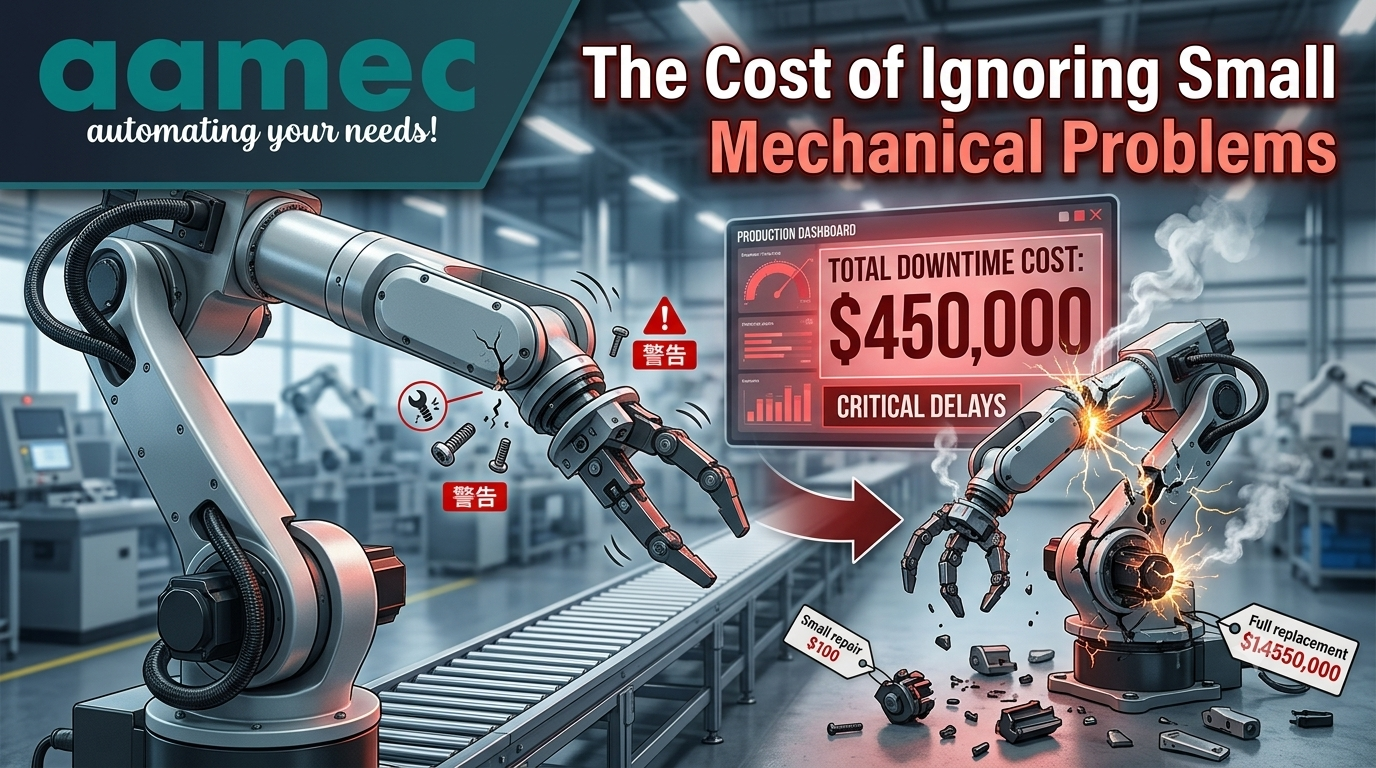
Ignoring a small mechanical problem can increase repair requirements, equipment downtime and overall maintenance expenditure. The longer a machine operates with an unresolved fault, the greater the possibility that additional components will be affected.
For example, a slightly misaligned rotating component may initially produce only minor vibration. Over time, that vibration can affect bearings, couplings, seals and connected equipment. What could have been a relatively simple corrective maintenance task may eventually require machinery repair, replacement components and extended downtime.
This is why early identification is an important part of preventive maintenance. The objective is not to eliminate every equipment problem, but to identify developing issues before they become difficult and expensive failures.
What Are Common Small Mechanical Problems?
Industrial machinery contains numerous moving and interacting components, so mechanical deterioration can occur in several ways. Some problems are visible during routine inspection, while others require vibration monitoring, temperature measurement, alignment checks or other technical methods to identify.
Excessive Vibration
Abnormal vibration is one of the most useful warning signs in rotating equipment. It can be associated with misalignment, imbalance, bearing deterioration, loose components, foundation problems or coupling issues.
A machine may continue to operate while vibration levels gradually increase. However, prolonged vibration can transfer additional mechanical loads to connected components and accelerate wear. Regular condition checks can help maintenance personnel determine whether the vibration is within an acceptable operating range or requires further investigation.
Poor Lubrication
Lubrication reduces friction between moving surfaces and helps control wear and operating temperature. Using the wrong lubricant, applying an incorrect quantity, contaminating the lubricant or missing scheduled lubrication can affect bearing and gear performance.
Poor lubrication may initially appear as increased noise or temperature. If the condition continues, friction and wear can increase significantly and eventually contribute to component failure. A properly planned mechanical equipment maintenance program should therefore include lubrication requirements based on the equipment manufacturer’s recommendations and operating conditions.
Misalignment
Shaft and coupling misalignment can create additional forces within rotating equipment. Even when the machine appears to be operating normally, incorrect alignment can increase vibration, bearing loading and coupling wear.
Alignment should therefore be considered whenever equipment is installed, moved, repaired or showing abnormal operating behaviour. Identifying alignment problems early can prevent associated components from experiencing unnecessary stress.
Bearing Wear
Bearings are critical components in many industrial machines. They support rotating shafts and allow movement with controlled friction. Excessive load, contamination, poor lubrication, incorrect installation and misalignment can all contribute to premature bearing deterioration.
Early warning signs may include unusual noise, increased temperature or vibration. A bearing problem that is identified during routine industrial equipment maintenance can often be addressed before it affects other parts of the machine.
Loose Mechanical Components
Loose bolts, fasteners, guards, mounting components or connections can cause vibration and movement during operation. The resulting movement may gradually damage nearby components.
Routine visual inspection and proper maintenance records can help identify recurring loose-component problems and determine whether the underlying cause is vibration, incorrect installation, structural movement or another mechanical issue.
How Small Problems Increase Mechanical Maintenance Cost
The relationship between a minor fault and a major repair can be understood as a progression. A component begins to deteriorate, the equipment continues operating, the deterioration affects connected components and the eventual failure requires more extensive intervention.
Consider a rotating machine with an early bearing problem. If the bearing is identified during a scheduled inspection, the maintenance team can plan the replacement around production requirements. If the bearing continues operating until failure, the resulting damage may involve the shaft, housing, coupling or other connected components.
This difference has a direct effect on mechanical maintenance cost. Planned maintenance allows businesses to organize labour, spare parts and downtime. Emergency machinery repair, on the other hand, can require immediate technical support and unplanned equipment shutdown.
| Small Mechanical Issue | Possible Technical Effect | Potential Consequence |
|---|---|---|
| Misalignment | Increased mechanical loading | Bearing and coupling wear |
| Poor lubrication | Increased friction and temperature | Premature component failure |
| Excessive vibration | Progressive component stress | Equipment damage |
| Bearing deterioration | Increased vibration and heat | Rotating equipment failure |
| Loose components | Movement during operation | Progressive mechanical damage |
| Worn coupling | Poor power transmission | Vibration and downtime |
The actual cost will vary depending on the machine, operating conditions, component availability and production requirements. However, the principle remains the same: identifying deterioration early generally gives maintenance teams more control over the repair process.
The Hidden Cost of Equipment Downtime
The cost of a mechanical failure is not limited to the replacement component. When critical equipment stops unexpectedly, the business may also experience production delays, idle labour, rescheduling, urgent spare-part procurement and additional technical support requirements.
For a manufacturing plant, the financial impact can therefore be much greater than the direct repair invoice. A machine that is part of a production line can also affect upstream and downstream processes. One equipment failure may consequently create delays across several stages of production.
This is why industrial maintenance should consider equipment criticality rather than treating every asset in exactly the same way. Critical machinery may require more frequent inspection and condition monitoring than equipment with limited impact on production.
Why Preventive Maintenance Helps Control Costs
Preventive maintenance involves performing planned maintenance activities before equipment reaches a failure condition. Depending on the machine, this may include lubrication, cleaning, tightening, alignment, inspection, component replacement and functional checks.
The objective is not simply to perform maintenance as frequently as possible. Excessive or unnecessary maintenance can also consume labour and resources. An effective maintenance program should consider equipment operating hours, manufacturer recommendations, operating environment, failure history and the importance of the equipment to production.
For businesses operating factories in the UAE, maintenance planning can be particularly important when equipment operates continuously or under demanding conditions. A documented maintenance schedule gives technicians a clear reference for inspections and helps management plan maintenance activities around production requirements.
How Equipment Inspection Helps Identify Problems Early
Regular equipment inspection provides an opportunity to identify physical and operational changes before they develop into major failures. Depending on the equipment, inspection may include visual checks, vibration measurement, temperature monitoring, lubrication assessment, alignment verification and examination of critical components.
Maintenance teams should also compare current observations with previous records. A gradual increase in vibration, temperature or noise can be more informative than a single measurement because it shows how the equipment condition is changing over time.
Professional mechanical inspection services UAE businesses use should be selected according to the equipment type, inspection requirement and applicable technical standards. The inspection process should produce useful information that can support maintenance decisions rather than simply generating a report.
Industrial Maintenance Challenges in the UAE
Industrial operations in Dubai and Abu Dhabi include manufacturing, engineering, construction-related operations, utilities, logistics and other sectors that rely on mechanical equipment. Different facilities have different operating schedules, machinery types and maintenance requirements, so a maintenance program should be developed around the actual equipment and working conditions.
Industrial areas such as Jebel Ali, Dubai Industrial City and Mussafah contain a wide range of industrial and engineering activities. Equipment used in these environments may operate for long periods and can include pumps, compressors, motors, conveyors, rotating machinery and other mechanical systems.
Businesses in Sharjah, Ajman and Ras Al Khaimah also operate manufacturing and industrial facilities where planned factory maintenance UAE practices can help reduce unexpected equipment problems. The appropriate inspection frequency will depend on the equipment, operating conditions, manufacturer’s requirements and previous failure history.
How to Prevent Small Mechanical Problems From Becoming Major Failures
The most effective approach is to combine routine observation with a structured maintenance process. Operators are often the first people to notice unusual sounds, vibration, temperature changes or changes in machine performance. These observations should be recorded and communicated to the maintenance team rather than being treated as normal machine behaviour.
Maintenance personnel can then investigate the issue and determine whether corrective action is necessary. Where equipment condition can be monitored, measurements such as vibration and temperature can help establish trends and identify deterioration.
Maintenance records are equally important. Recording previous failures, component replacements, inspection findings and recurring problems allows the maintenance team to identify patterns. If the same bearing, coupling or component repeatedly fails, simply replacing it may not address the underlying cause.
A good industrial equipment maintenance UAE program should therefore combine inspection, preventive maintenance, corrective action and maintenance history. This provides a more complete picture of equipment condition and helps businesses make informed maintenance decisions.
Mechanical Maintenance Checklist
A basic inspection routine can help maintenance teams identify common warning signs:
- Check for unusual vibration during operation.
- Listen for abnormal mechanical noise.
- Inspect bearings and rotating components.
- Check lubrication condition and application.
- Examine belts, couplings and other transmission components.
- Look for loose fasteners or mounting problems.
- Check for abnormal temperature increases.
- Review previous maintenance and failure records.
- Investigate repeated component failures.
- Schedule corrective maintenance when deterioration is identified.
The exact inspection procedure should always be adapted to the equipment type and manufacturer’s requirements. Critical equipment may also require more detailed condition monitoring or specialized inspection techniques.
When Should a Mechanical Problem Be Investigated Professionally?
Professional investigation should be considered when a mechanical problem continues to return, becomes more severe or affects equipment performance. Persistent vibration, repeated bearing failures, abnormal temperatures, unusual noise and unexplained production interruptions are examples of conditions that should not simply be ignored.
Professional assessment can also be useful when maintenance personnel cannot identify the root cause of a recurring problem. Finding the underlying cause is important because repeatedly replacing the failed component without correcting the source can increase long-term equipment maintenance cost.
For industrial facilities in Dubai, Abu Dhabi and across the UAE, the appropriate technical support will depend on the equipment and the nature of the problem. Inspection and testing should be planned according to the actual operational and technical requirements of the facility.
How AAMEC Supports Industrial Operations
AAMEC supports industrial and engineering requirements through inspection, testing and related technical services. For businesses managing industrial equipment, professional technical assessment can provide additional information when equipment condition, performance or recurring problems require closer investigation.
For companies operating in Dubai, Abu Dhabi and other UAE industrial locations, selecting the appropriate inspection or testing approach should depend on the equipment type, operating environment, maintenance history and specific technical requirement. A structured approach can help businesses obtain useful technical information for maintenance planning and equipment management.
Frequently Asked Questions
What is mechanical maintenance cost?
Mechanical maintenance cost refers to the expenses associated with inspecting, maintaining, repairing and replacing mechanical equipment and components. It can include labour, spare parts, inspection, planned maintenance and emergency repair expenses. The actual cost depends on equipment type, operating conditions, failure frequency and the maintenance strategy used by the facility.
Why should small mechanical problems be repaired early?
Small problems can develop into larger failures when equipment continues operating under abnormal conditions. Early corrective action can help limit component damage, reduce unplanned downtime and give maintenance teams greater control over labour, spare parts and repair scheduling.
What are common signs of mechanical equipment problems?
Common warning signs include unusual vibration, abnormal noise, increased operating temperature, lubrication problems, visible wear, leakage, unusual movement and repeated component failure. Changes in normal machine performance should be recorded and investigated rather than automatically treated as normal operation.
How does preventive maintenance reduce equipment failure?
Preventive maintenance uses planned inspections and maintenance activities to identify deterioration and address known maintenance requirements before equipment reaches a failure condition. When properly planned, it can help reduce unexpected breakdowns and improve equipment reliability.
How often should industrial equipment be inspected?
There is no single inspection frequency suitable for every machine. The schedule should consider equipment type, manufacturer recommendations, operating hours, environmental conditions, criticality and previous failure history. High-risk or critical equipment may require more frequent monitoring.
Can regular equipment inspection reduce maintenance costs?
Regular equipment inspection can help identify developing faults before they result in extensive damage. Early detection may allow businesses to plan repairs, organize spare parts and reduce emergency intervention. However, inspection alone does not guarantee lower costs; it needs to be combined with appropriate maintenance action.
Where can businesses find industrial equipment inspection services in the UAE?
Businesses can evaluate professional mechanical inspection services UAE providers based on their technical capabilities, relevant experience, equipment requirements and applicable inspection standards. Facilities in Dubai, Abu Dhabi, Sharjah and other UAE industrial areas should select services according to the specific equipment and inspection requirement.
Conclusion
Small mechanical problems should not be judged only by their immediate effect on machine operation. A bearing that is beginning to wear, a coupling that is misaligned or a machine showing abnormal vibration may continue operating for some time, but the underlying deterioration can progressively affect other components.
A structured industrial equipment maintenance program combines routine inspection, preventive maintenance, condition monitoring and proper maintenance records. This allows businesses to identify developing problems, plan corrective work and manage mechanical maintenance cost more effectively.
For industrial facilities across the UAE, including Dubai, Abu Dhabi, Sharjah and other manufacturing locations, addressing mechanical problems early can support more predictable maintenance planning and reduce the risk of unexpected equipment interruptions.